Work · Fintech · Reliability
Automations break quietly and leads get lost
What I built: Automations that don’t break quietly
43 workflows, 700 production runs, 0.4% failure. Automation a fintech’s sales team runs on every day.
Same client as the other fintech examples.
700 live runs, only 3 failed (0.4%) (verified)
700 runs (verified) 0.4% failure (verified) 43 workflows (verified)
Verified = seen in the system. Self-reported = my own measure.
Automations break quietly.
Marketing automations usually break quietly.
Nobody notices until a lead is lost.
Logs, retries and a failure rate you can see.
- 43 workflows with a clear naming system (SYNC, ACTION, STAGE, MIGRATION), so anyone can see what each one does.
- Retries, batching and a run log on the sync jobs.
- 5 read-only probe workflows that test an API before anything writes to it.
- A scheduled deal-stage job that keeps stages and pricing fields tidy.
Step by step
- Every workflow name says what it does and how it runs.
- Before building on an API, a read-only probe checks it.
- Sync jobs work in batches, retry failed rows and log every run.
- The failure rate is visible in n8n, so anyone can check it.
Screenshots
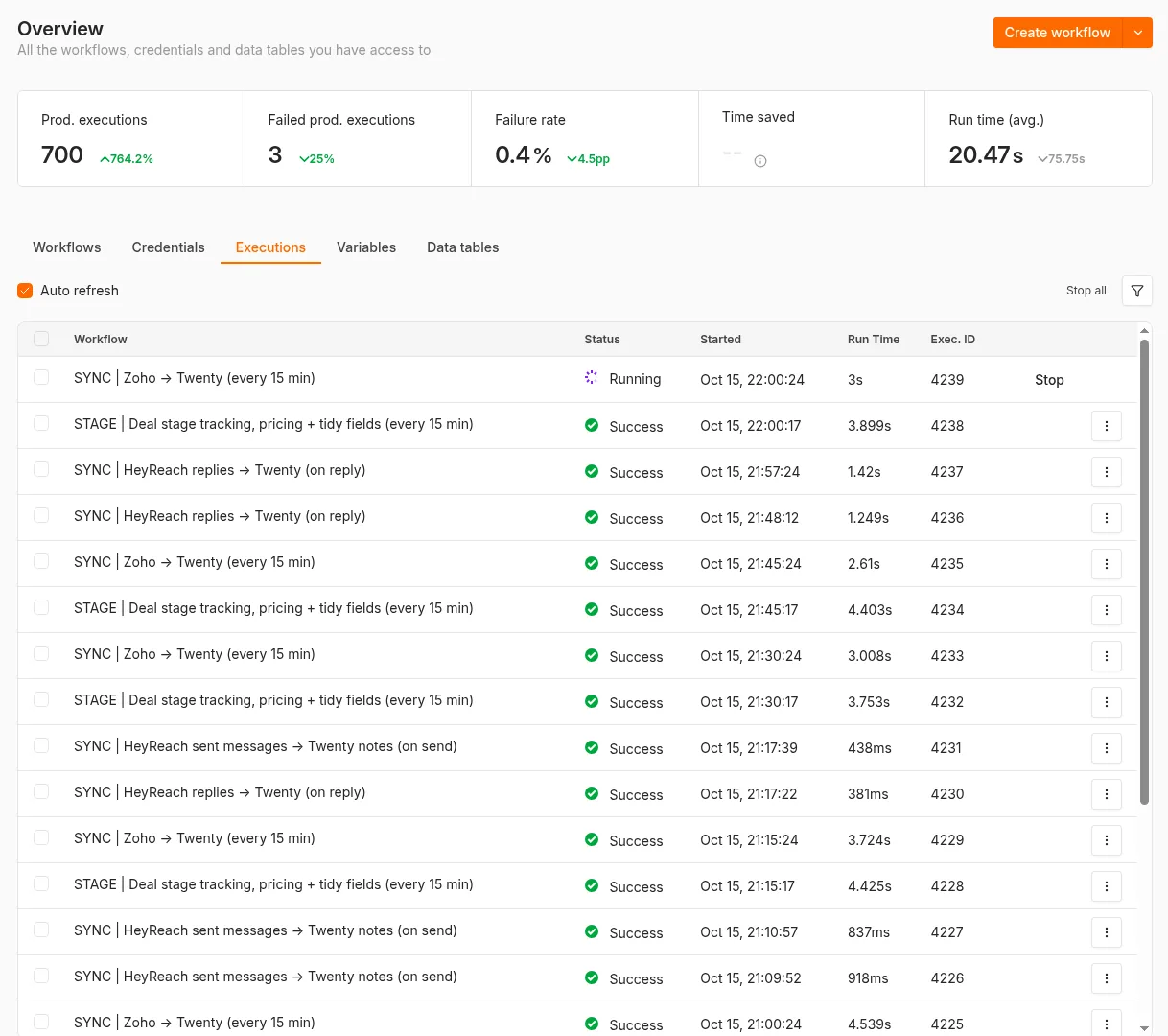 Production runs and failure rate in n8n.
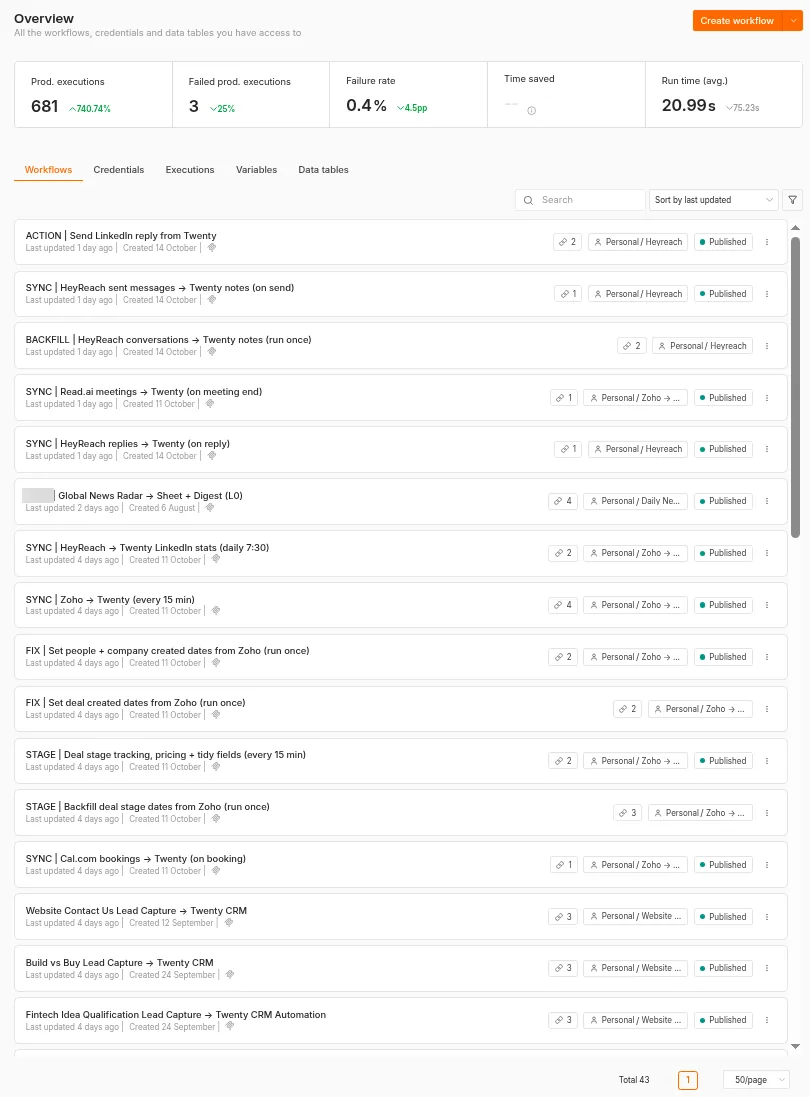 The workflow list and naming system.
How I built it
- I worked inside the team’s own tools: their self-hosted n8n and their self-hosted Twenty CRM.
- I wrote the workflows with Claude Code as my AI coding tool (self-reported). I decided what to build and checked every run.
- Read-only probe workflows tested each API before anything wrote to it.
What you can check
- Verified: 43 workflows. 700 production runs, 3 failed: a 0.4% failure rate. Average run 20 seconds. Source: n8n execution overview, 15 Oct 2026
Take the workflow, free
- Read-only API probe (Apollo people search): Tests an API safely before you build on it.
What this means for your team
I don’t hand over a demo. I hand over automations with logs, retries and a failure rate you can check.
Tools
- n8n (self-hosted)
- Twenty API
- Webhooks